

5 Parent Communication Tips For Elementary Teachers
Does your stomach flip a little whenever you need to contact a student's parent?
Mine did.
During my first few years of teaching, I always wondered how parents would react or what questions they might ask.
Over time, I realized something important:
Parent communication became much easier when I had a plan.
These five simple strategies completely changed the way I communicated with families and helped us work together as a team.
Get the Free Back-to-School Toolkit!
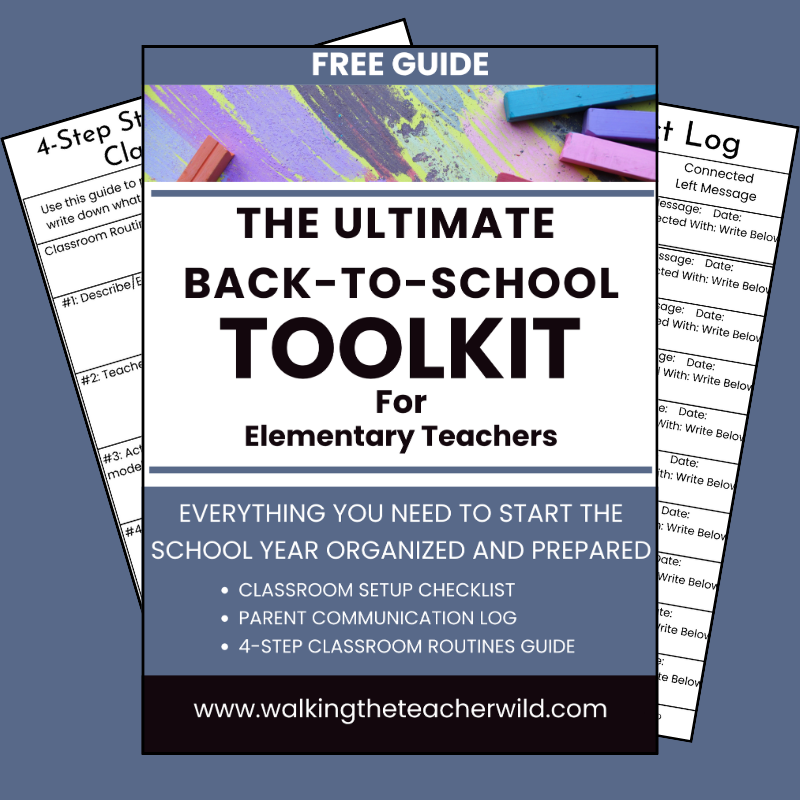
Want this classroom routines guide plus two additional back-to-school resources?
Download The Ultimate Back-to-School Toolkit For Elementary Teachers, which includes:
Classroom Setup Checklist
Parent Communication Log
4-Step Classroom Routines Guide
Download The Free Toolkit → Free Ultimate Back-to-School Toolkit
Tip #1: Make a Positive Parent Contact The First Week of School
Why This Works
I understand the first week of school is incredibly busy and stressful! However, the year I started making positive parent contacts the first week of school made such a wonderful difference in how my communication with parents continued the rest of the year!
When you take the time to initiate parent contact about positive acts in the classroom, it demonstrates to parents and students that you look for and acknowledge positive behaviors.
It also shows that you are willing to take the time out of your day to communicate those positive actions to parents. Now, getting a phone call or text from the teacher is no longer just a sign of trouble.
The first week, I printed off a class set of The Parent Communication Log pages, and I used these pages for the initial positive parent contacts. I recorded five-six student names per day on the log and made the calls, texts or sent emails.
I continued each day until all of my students received a positive call the first week. I made a point to start with the students that were showing signs of struggling when following directions, interacting with other students, or being respectful.
Start With Students Who Need It Most
If I knew from a previous teacher that a student struggled with completing work or behavior, I made it a point to call the first day. This enabled me to catch the positive moments and relay them before I had to touch base about any behavior that needed work.
One year, I had a parent say to me when I called,
“No one has ever called me to tell me something good like that before!”
From that moment on, the parent and I became a team that worked together to help the student thrive in the classroom.
Learn Each Family's Preferred Communication Method
The first week of school, I initially made a phone call unless I already knew from our Open House a parent’s preferred method of communication, such as texts or emails. If I was not able to leave a message, I sent a positive note home with the student instead.
This process also helped me gather the preferred method of contact for each family. Then I knew I had current numbers and emails, and I wouldn’t accidentally wake up a parent who works third shift.
Tip #2: “I’m Just Letting You Know…”
This became my go-to phrase that I used when connecting with parents. I found that parents were very receptive when I used this phrase because:
It’s nonjudgemental
I never asked the parents to do anything specific, such as implement a consequence at home. That was for the parent to decide. I had already implemented a consequence at school.
I wanted to make a point to parents that I was communicating what was happening in the classroom as soon as possible, so the student had time to stop the behavior before a more serious consequence might be needed.
Tip #3: Be The First One To Connect
I always made it a point to contact the parent as soon as possible. I found that parents were much more willing to listen when they first heard about a situation from me, the teacher, rather than the student or someone else.
If I couldn't fully investigate a situation before dismissal, I still contacted parents the same day. I let them know I was aware of what had happened, that I would finish gathering information the next day, and that I'd follow up after speaking with the students.
Parents were extremely receptive and appreciative that I kept them in the loop.
Tip #4: Keep Helpful Parent Communication Scripts Nearby
There were times during my first few years of teaching that I became flustered, and I didn’t always communicate what I wanted to say in the best way. I wrote a list of phrases and kept that list in front of me when I called parents until these phrases became more natural. Phrases such as:
“I’m just letting you know…”
“I cannot tell you the name of the other student(s) due to privacy reasons.
I am happy to speak with our principal and relay our conversation.
Yes, I can ask the principal to call you. I don’t know his/her schedule, so I can’t tell you the exact time that he/she will reach out.
I understand.
Thank you so much. I really appreciate us working as a team to support (enter name of student)!
Making a point to write out these phrases during my first few years really helped me keep the conversation on point and positive when speaking with parents.
Tip #5: Parent Communication Log
Keep a log throughout the school year. Write down every time you communicate with parents, whether it’s for positive situations or incidents that need work.
It is so helpful to be able to look back and see how many times you’ve spoken to or reached out to parents. A log gives you the ability to show your principal, or anyone else who needs to know, that you have kept parents informed throughout the year about both positive behavior and any behavior that you are concerned about.
Remember to write down whenever you have reached out to parents, even if you did not actually speak with a person or receive a reply.
Implementing these 5 Parent Communication Tips really strengthened confidence in my communication skills when it came time to speak with parents. I believe using these strategies created positive interactions with parents and inspired a sense of collaboration and teamwork, which enabled us to strengthen student support!
A Parent Communication Log helps you keep track of every conversation throughout the year. You'll find the same type of log inside my free Back-to-School Toolkit.
Tip: I also repeated these strategies after Winter Break to reconnect with families and start the second half of the school year on a positive note.
Want Even More Back-to-School Support?
This classroom setup guide is one part of my Ultimate Back-to-School Toolkit, designed to help you start the school year feeling organized and confident.
Inside you'll get:
Classroom Setup Checklist
Parent Communication Log
4-Step Classroom Routines Guide
Download the FREE Toolkit → The Ultimate Back-to-School Toolkit
Continue Reading: