

Consequences In The Classroom
Choosing appropriate consequences in the classroom can be challenging for teachers.
While there are many approaches to classroom management, understanding the difference between natural, logical, and emotional consequences can help teachers respond consistently and effectively while maintaining a positive learning environment.
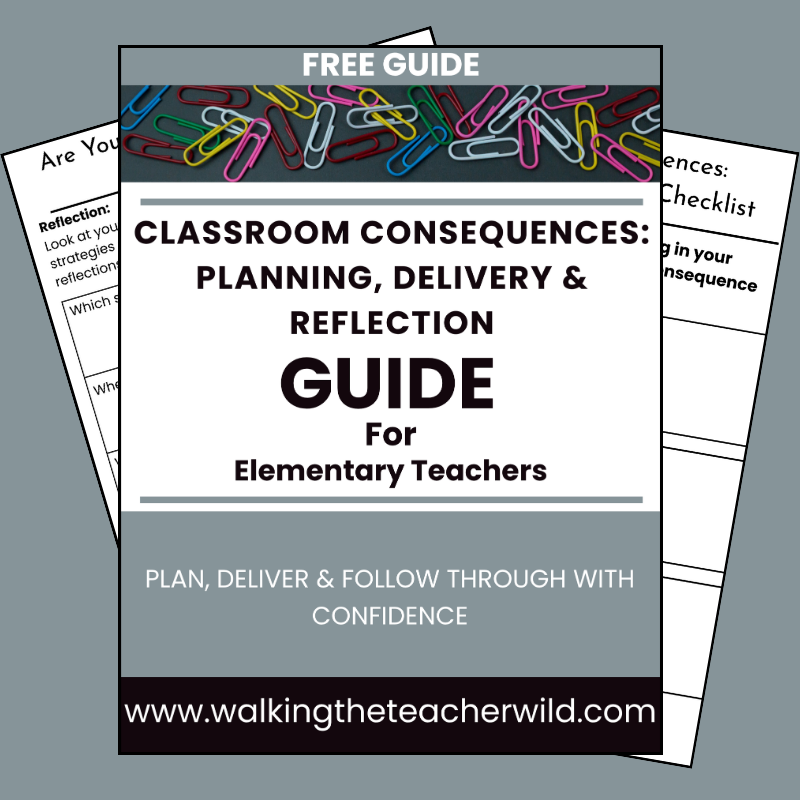
Grab The Free Classroom Consequences: Planning, Delivery & Reflection Guide
Want a simple way to plan, deliver, and reflect on classroom consequences?
Download the free guide and get three practical tools to help you create more consistent responses to student behavior:
Classroom Consequences: Planning & Reflection Checklist
4 Strategies To Use When Delivering Consequences Guide
Are You Giving Directives or Giving Choices? Reflection Guide
Download The Free Guide → Classroom Consequences: Planning, Delivery, & Reflection
There are varying opinions from teachers and administrators when it comes to the kinds of consequences to give students.
Many teachers agree that natural consequences work well when it comes to addressing student behavior.
I’ve been asked a lot recently, “What exactly are natural consequences?”
Natural consequences are the automatic result of a student’s actions, without adult intervention. Here are some examples:
A student refuses to wear a coat outside and then feels cold.
A student refuses to eat their lunch and then feels hungry later.
A student is consistently mean to other students at recess, and then the other students don’t want to play with him/her anymore.
Now, as a teacher and adult who can foresee those natural consequences, I still stepped in to direct students and help them think through their actions if I knew what was happening.
For instance, if the temperature is 10 degrees Fahrenheit outside I am not going to ignore a student leaving their coat in their locker and risk frostbite. The student will not be allowed outside without the proper outdoor clothing.
So, natural consequences are often good lessons for students as long as they experience mild discomfort and not dangerous situations. Adults obviously need to intervene if a student’s safety is at risk.
Types of Classroom Consequences
Logical Consequences:
The next step in the consequence ladder are logical consequences. Logical consequences go hand-in-hand with the student’s behavior and the rules.
Here are some examples:
A student pushes or yells at other students so they can be first in line.
Consequence: The student is sent to the back of the line and is now last for the next class event.
A student pushes papers off their desk and creates a mess right before a special class such as Art, Music, or P.E.
Consequence: The student has to clean up the mess before he/she can go and participate in the special class, which means he/she will miss out on some of the time and activities.
A student refuses to complete any work during designated work time.
The student has to complete work at a class fun time and miss some of that fun time.
Logical consequences go along naturally with the student’s behavior and the classroom rules, but are implemented by an adult.
Emotional Consequences:
Then, there are the emotional consequences. These consequences are usually uttered by adults when they are exasperated by a student’s continuous behavior.
I’ve heard administrators tell a student he/she would not have recess the rest of the year if they didn’t stop their behavior… and it was October.
Which is when I peak over and ask myself, “Who’s implementing that consequence?! Not I, said the Duck!”
I understand the thinking behind stating extreme consequences, that it will shock the student, and they will rethink their behavior and stop.
But students instinctively know that the adult probably won’t be able to implement that extreme consequence, so it backfires and ends up empowering students.
I have also winced as I stated a consequence without thinking it through. We have all been there!
So, what can we do?
How To Avoid Emotional Consequences
Here are examples of what you can do to help prepare yourself to give out logical consequences when necessary and avoid those emotional disasters.
Write down some reoccurring behaviors that are happening in your classroom right now and a logical consequence that would work for that situation.
Practice stating the consequence in a calm voice when you are by yourself or ask a teacher bestie to help you.
If something occurs and you are not sure what the consequence should be, here is what you can say: “That was not O.K. to do. There will be a consequence. I will speak with you later about your consequence.”
By saying this you are stopping the behavior and letting the student know that there will be a consequence, but you are giving yourself time to think, so it will be a logical consequence and not an emotional one.
5 Additional Logical Consequences To Use In Your Classroom
A student continues to bother their seat partner by talking or touching their supplies.
Consequence: The student is moved to a quiet space and works by him/herself. The student loses the opportunity to ask a seat partner questions during work time.
A student continues to get up and walk around the room and talk with other students during work time.
Consequence: The student is “grounded” to their seat and loses the opportunity to get up for supplies. Note: When this happens, I hand the student any supplies needed and an extra pencil, so the student has what he/she needs to finish work.
A student mistreats technology such as a Chromebook or an iPad.
Consequence: I removed the technology from the student’s desk and gave the student a pencil/paper assignment instead. Note: I always had a few pencil/paper assignments for Reading and Math made up ahead of time to prepare for this consequence.
At Student Lockers: A student took too long to get their belongings, bothered other students or was unsafe.
Consequence: The student had to wait to be called to their locker until I had time to monitor his/her behavior. Since I was often helping others at this time, the student would be the last person to get their things, and as a result was late to our next event.
A student copies another student’s answers.
Consequence: The student has to complete another assignment at a fun time. Note: The assignment doesn’t have to be long. I usually asked them to complete five-10 additional problems, so I knew if he/she understood the assignment. However, the student still missed some of his/her fun time to complete the work.
Tips for Using Logical Consequences Successfully
I always gave students one warning before implementing a consequence. If the student stopped the behavior after the warning, I didn't need to implement the consequence. However, I only gave one warning. If the behavior continued, I followed through with the consequence. When students know multiple warnings are coming, there may be less incentive to immediately change the behavior.
If the student was moved to a quiet spot, he/she was invited back to his/her desk once the work time was completed and the student had stopped the behavior.
Yes, some of these consequences made some extra work for me. However, I found that implementing consequences such as these reduced the amount of misbehavior because students knew I followed through with consequences every time.
Classroom Layout: Create some quiet spaces around your room ahead of time, so you don’t have to decide at that moment where to send students.
Paper/Pencil Work: Make some Reading and Math worksheets to hand to students if needed.
Pencils: Keep a teacher’s supply of sharpened pencils, so that you can simply hand a student a pencil if you have to “ground” the student to their seat, or you are in the middle of a lesson.
Implementing consistent, logical consequences in the classroom reduces misbehavior because students know you are going to follow through every time.
Final Thoughts
Logical consequences help students connect their choices with appropriate outcomes while preserving respectful teacher-student relationships.
When consequences are calm, consistent, and directly related to the behavior, students know what to expect and are more likely to make better choices in the future.
Over time, these consistent classroom management practices help create a safe, predictable learning environment where students can focus on learning.
Continue Strengthening Your Classroom Management
If you're looking for more practical classroom management strategies, these articles build on the ideas you've learned here.
4 Effective Strategies for Teachers When Delivering Consequences
Discover practical techniques for delivering consequences calmly, consistently, and effectively while preserving positive relationships with students.
The Mistake Teachers Make When Giving Directives (That Accidentally Gives Students a Choice)
Learn one simple communication change that helps students understand expectations and reduces classroom behavior problems before they begin.
Keep Building Your Classroom
I'm Getting Ready for Back-to-School
FREE Back-to-School Toolkit
Get organized before the first day with a Classroom Setup Checklist, Parent Communication Log, and 4-Step Classroom Routines Guide.
I Want My Classroom to Run More Smoothly
Free Classroom Layout Guide
Learn simple classroom setup strategies that support smoother routines, stronger classroom management, and more successful small groups.
I Want to Stay Organized All Year
Academic Planner & Organizer
Keep lesson plans, student data, parent communication, behavior notes, meetings, and small groups organized in one printable planner.
I Want Better Small Groups
Small Groups Blueprint
Learn my complete step-by-step system for planning, organizing, and running successful small groups with fewer interruptions.
I Need More Math Practice
Math Facts Board Games Bundle
Hands-on board games that make math fact practice engaging and build fluency through repeated play.
Math Facts Card Games Bundle
Easy-prep card games students enjoy while building addition, subtraction, multiplication, and division fluency.
I'm Looking for More Free Teaching Ideas
Visit the blog for classroom organization, classroom management, small groups, behavior strategies, educational technology, and free resources.