

4 Effective Strategies for Teachers When Delivering Consequences
In a previous article, we explored the different types of classroom consequences, including natural, logical, and emotional consequences.
Once you've decided which consequences fit your classroom, the next step is learning how to deliver them in a calm and consistent way.
These four strategies work best when used together.
They help reduce power struggles, preserve teacher-student relationships, and keep the focus on changing the behavior rather than embarrassing the student.
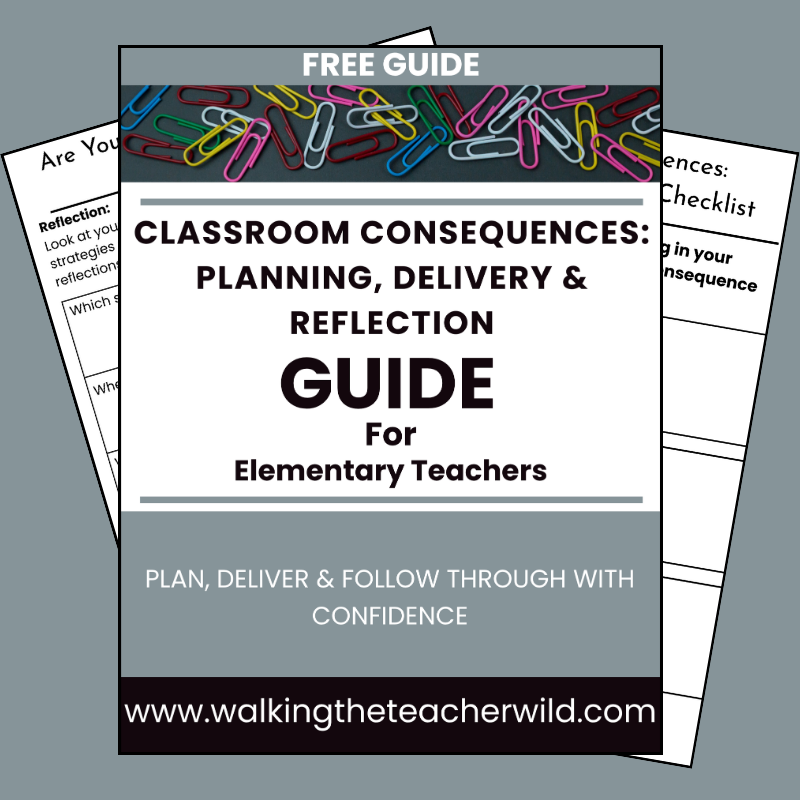
Grab The Free Classroom Consequences: Planning, Delivery & Reflection Guide
Want a simple way to plan, deliver, and reflect on classroom consequences?
Download the free guide and get three practical tools to help you create more consistent responses to student behavior:
Classroom Consequences: Planning & Reflection Checklist
4 Strategies To Use When Delivering Consequences Guide
Are You Giving Directives or Giving Choices? Reflection Guide
Download The Free Guide → Classroom Consequences: Planning, Delivery, & Reflection
4 Strategies To Use When Delivering Consequences
Proximity: How close you are standing to the student
Voice: Use a calm, low voice
Privacy: Whenever possible, hold the conversation in private, so other students cannot hear what is being said.
State the behavior in a matter-of-fact way: Direct and Non-emotional
Strategy #1 Use Proximity When Delivering Consequences
When you are giving students consequences it’s important to remember proximity. Proximity is how physically close you are to the student. It’s more effective when speaking to a student to stand closer to the student, rather than call across the classroom.
I observed an example of this last summer while I was at the park. An adult wanted a child to stop bothering others and move away from the swings. The adult was sitting on a bench across the playground. When the adult gave directions, the child ignored them and kept on bothering other kids. This child continued his behavior while the adult repeated herself a couple more times.
However, when the adult stood up and walked over to the swings, the child immediately followed directions and moved over to the slide instead.
It is easy for teachers to forget how powerful simply standing next to a student when giving directions or a consequence can be, especially when we are in the middle of working with other students.
Strategy #2 When Delivering The Consequences Use A Calm, Low Voice
Whenever I gave consequences I made sure my voice was calm, and I lowered the tone of my voice as well. This demonstrated to the student that I was serious and this was not an emotional response to the student’s actions.
I calmly touched base with the student and told them directly what the student was doing that was not tolerated in our classroom. Then, I told the student what the consequence was going to be.
For example: A student is pushing to get into the front of the line.
Consequence: When I saw a student pushing into the line, I called the student over to me and stated, “ You are pushing into the line. Walk to the end of the line.”
Strategy #3 Talk With A Student Privately When Giving A Consequence
Whenever it is possible, talk with a student privately when giving a consequence. I often called a student over and we stood just outside the doorway of the classroom during work time.
This way, I could still see the entire classroom, and I could talk privately with the student. The other students couldn’t hear what was being said.
Talking privately with students usually prevented power struggles in the classroom, and students were often much more willing to follow directions when the situation was kept between the student and me.
When an adult calls out a student’s behavior in front of the classroom, it can embarrass or anger the student, and the student may start to argue or escalate their behavior in retaliation.
By discussing the matter privately, it often eliminated the student’s need to grandstand in front of the other students, and the classroom could continue the work time undisturbed.
Strategy #4 State the Behavior Directly and Non-emotionally
Stating the behavior in a matter-of-fact way is a great strategy to keep the behavior separate from the student. It’s the behavior that needs to stop, and not a personal attack on the student themselves.
Also, by being direct and non-emotional when you tell the student which behavior you are noticing, it doesn’t leave room for the student to argue or pretend they don’t know what you mean, which can prevent issues before they start.
Here are some examples:
Say This:
“You are talking instead of working.”
“You are tapping your pencils.”
“You’ve gotten out of your seat six times in five minutes.”
Don’t Say This:
“Everybody can hear you!”
“You are driving everyone in this class crazy with the pencils!”
“Everyone is tired of you getting out of your seat so much!”
Saying things in a way that calls out or embarrasses the student sets you up for a power struggle. This can lead to arguing and refusing to follow directions, and an escalation of behavior.
Stating the behavior in a direct, non-emotional way puts the focus on the behavior and not the student themselves.
Combine These 4 Strategies When Delivering Consequences
Here is an example of what the 4 Strategies look like when implemented together:
A student continues to talk to other students instead of completing work.
Either walk over to the student or call the student to walk over to you. (Proximity & Privacy)
Give the student a warning. Speak in a calm, low voice. “You are talking instead of working. Please get back to work. If you do not, you will have to sit by yourself for the rest of the work time.” (Focus on the behavior: Direct and Non-emotional)
If the student stops talking and works, then nothing else needs to be said or done.
If the student continues to talk, then implement the consequence.
Either walk over to the student or call the student to walk over to you.
Tell the student again in a calm, low voice. “You are continuing to talk instead of completing your work. Take your things and sit over there. (Point to the appropriate spot and watch student follow directions)
Managing classroom behavior with effectiveness requires strategic approaches. By utilizing proximity, using a calm voice, ensuring privacy, and stating behaviors directly, you can maintain a positive learning environment and prevent additional issues before they begin.
Final Thoughts
The way we deliver consequences is just as important as the consequence itself.
Using proximity, speaking calmly, protecting student privacy, and focusing on the behavior rather than the student helps reduce power struggles while reinforcing classroom expectations.
Over time, students learn that consequences are predictable, fair, and intended to help them make better choices—not to embarrass or punish them.
Continue Strengthening Your Classroom Management
These articles will help you continue building calm, consistent classroom management systems that prevent problems and strengthen student responsibility.
Consequences in the Classroom
Learn how to choose natural and logical consequences that teach responsibility while supporting a positive classroom environment.
The Mistake Teachers Make When Giving Directives (That Accidentally Gives Students a Choice)
Discover one simple communication change that helps students understand expectations and reduces classroom behavior problems before they begin.
Keep Building Your Classroom
I'm Getting Ready for Back-to-School
FREE Back-to-School Toolkit
Get organized before the first day with a Classroom Setup Checklist, Parent Communication Log, and 4-Step Classroom Routines Guide.
I Want My Classroom to Run More Smoothly
Free Classroom Layout Guide
Learn simple classroom setup strategies that support smoother routines, stronger classroom management, and more successful small groups.
I Want to Stay Organized All Year
Academic Planner & Organizer
Keep lesson plans, student data, parent communication, behavior notes, meetings, and small groups organized in one printable planner.
I Want Better Small Groups
Small Groups Blueprint
Learn my complete step-by-step system for planning, organizing, and running successful small groups with fewer interruptions.
I Need More Math Practice
Math Facts Board Games Bundle
Hands-on board games that make math fact practice engaging and build fluency through repeated play.
Math Facts Card Games Bundle
Easy-prep card games students enjoy while building addition, subtraction, multiplication, and division fluency.
I'm Looking for More Free Teaching Ideas
Visit the blog for classroom organization, classroom management, small groups, behavior strategies, educational technology, and free resources.