


The Mistake Teachers Make When Giving Directives (That Accidentally Gives Students a Choice)
Giving clear directives is an important part of effective classroom management.
While offering students choices is a great strategy in many situations, there are also times when teachers need students to follow a direction immediately.
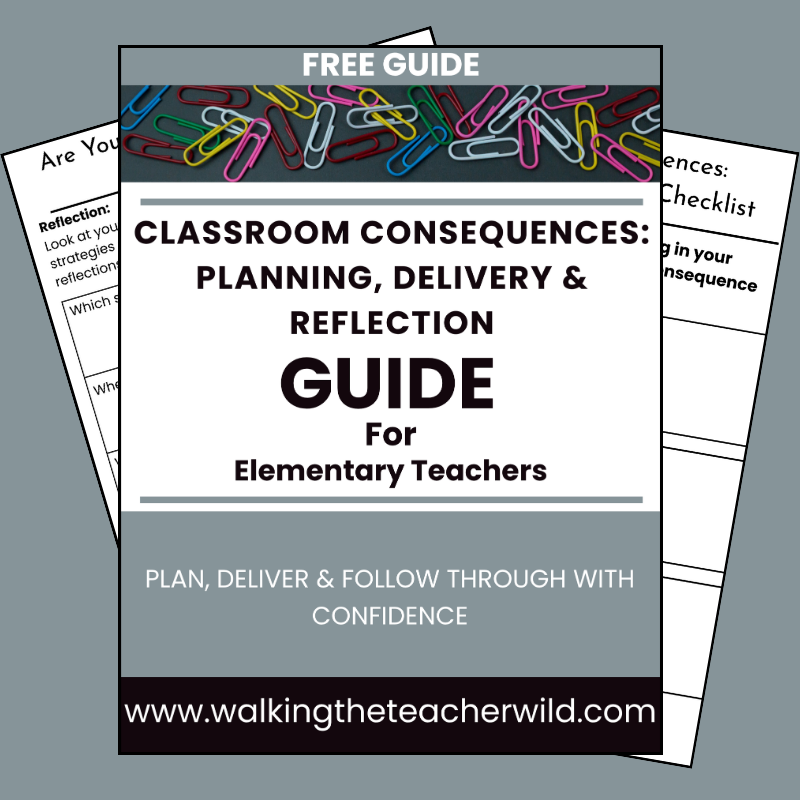
Grab The Free Classroom Consequences: Planning, Delivery & Reflection Guide
Want a simple way to plan, deliver, and reflect on classroom consequences?
Download the free guide and get three practical tools to help you create more consistent responses to student behavior:
Classroom Consequences: Planning & Reflection Checklist
4 Strategies To Use When Delivering Consequences Guide
Are You Giving Directives or Giving Choices? Reflection Guide
Download The Free Guide → Classroom Consequences: Planning, Delivery, & Reflection
One small word can accidentally turn a clear directive into a choice and create an unnecessary power struggle.
This is where we can unintentionally trip ourselves up by inserting this seemingly harmless word. Ready for the word? The word is… "Okay?”
When you add “Okay?” at the end of your directive, you are automatically giving the student a choice to either agree or disagree with you. Often, when you add the word “Okay”, you get a resounding, “No!”
This creates a power struggle, and the student often feels as though their words and/or feelings are being disregarded, and the student begins to argue with you.
When I first realized this, I thought to myself, “I use the word 'okay' all the time!” However, I add the word 'okay' when I am talking with adults.
To me, it’s considered polite to check in with my friends and family when I am making plans or handling a situation. I might say:
“I will meet you at the coffee shop at 4:00 today, okay?”
“I need you to pick up the kids from school today. I have another meeting, okay?”
When you add “Okay” when speaking with adults, it softens what you are saying and doesn’t sound like you’re ordering them around. It’s a way to check in and see if they agree with what you are saying to them.
Also, if the adult I’m talking to says, “No, that won’t work.” Then we renegotiate our terms, so it works for both of us.
However, this habit can seep into your directives with students.
The result is that students may interpret your directive as something they can negotiate instead of an expectation that needs to be followed.
How to Give Clear Directives Without Creating a Power Struggle
When you are giving a directive to students, you can avoid the power struggle by replacing the word “Okay” with the word “Understand?”
Or, if you are working with older students, you might add on, “Got it?”
If I had a student who seemed to enjoy arguing, who refused to answer, or who often responded with, “No! I don’t understand.” Then I changed my directive to: “It’s important to complete your work now, at work time, or you will complete it at our fun time. Nod your head if you understand.”
Sometimes, just changing things slightly and asking them to nod their head, instead of responding verbally, takes the pressure off, and the student will nod their head and get back to work.
What Do I Do If My Student Still Says “No!” Or Argues With Me?
If my student still shakes their head, “No!” or “No, I don’t understand!” then I respond by saying this: “If you don’t understand why I am telling you to do this, then we can talk about it further at our fun time. It’s still important that you follow directions right now.”
Students catch on quickly that they will lose some of their free time or fun time if they have to talk with you further about what’s happening.
If you continue to be consistent by stating the directive and following up if the student argues, students will know they will lose something that is important to them by continuing to argue.
I always said to my students, “We can’t take Math time to talk about this, so I can explain it more to you in our free time.”
I found this stopped students from saying they don’t understand just to argue, and they usually followed the directions.
However, my students knew that if they really wanted to talk with me, then we could make time to do that, although it was often during some of our free time.
I knew if students didn’t mind missing their free time to talk about a situation, then it was important to them.
This helped me determine if a student was arguing just to argue, or if the student really had something on their mind. If this was the case, I tried to find another time if possible, but some days our schedule was so full it was difficult to find a time other than free time.
Practice Giving Clear Directives
It took me some time to practice replacing the word “Okay?” with the word “Understand?”.
Practice what you are going to say to students:
If you have situations that keep repeating this year, then take the time to write out your script of what you are going to say. Then, practice saying it to yourself, such as:
“We have five more minutes of recess, and then it’s time to line up, understand?”
“Start completing your work now, while it’s work time, so you don’t have to complete it during our free time, understand?”
You can practice saying it to yourself or enlist a teacher bestie and practice your scripts with each other.
It will take some time and consistency, but I found that when I stopped saying, “Okay?” and replaced it with “Understand?” the number of students who argued with me decreased dramatically.
Final Thoughts
Sometimes the smallest changes make the biggest difference in classroom management.
Replacing "Okay?" with "Understand?" helped me reduce unnecessary arguments, eliminate many power struggles, and communicate expectations more clearly.
Like any classroom management strategy, it takes consistency and practice, but once students understand your expectations, giving directions becomes much smoother.
Continue Strengthening Your Classroom Management
If you're looking for more practical classroom management strategies, these articles are a great next step.
Consequences in the Classroom
Learn how to choose logical consequences that reinforce expectations while maintaining positive teacher-student relationships.
4 Effective Strategies for Teachers When Delivering Consequences
Discover simple techniques for delivering consequences calmly, consistently, and effectively.
Keep Building Your Classroom
I'm Getting Ready for Back-to-School
FREE Back-to-School Toolkit
Get organized before the first day with a Classroom Setup Checklist, Parent Communication Log, and 4-Step Classroom Routines Guide.
I Want My Classroom to Run More Smoothly
Free Classroom Layout Guide
Learn simple classroom setup strategies that support smoother routines, stronger classroom management, and more successful small groups.
I Want to Stay Organized All Year
Academic Planner & Organizer
Keep lesson plans, student data, parent communication, behavior notes, meetings, and small groups organized in one printable planner.
I Want Better Small Groups
Small Groups Blueprint
Learn my complete step-by-step system for planning, organizing, and running successful small groups with fewer interruptions.
I Need More Math Practice
Math Facts Board Games Bundle
Hands-on board games that make math fact practice engaging and build fluency through repeated play.
Math Facts Card Games Bundle
Easy-prep card games students enjoy while building addition, subtraction, multiplication, and division fluency.
I'm Looking for More Free Teaching Ideas
Visit the blog for classroom organization, classroom management, small groups, behavior strategies, educational technology, and free resources.